
‘Why?’ vs. ‘What Now?’
- Apr 20
- 4 min read
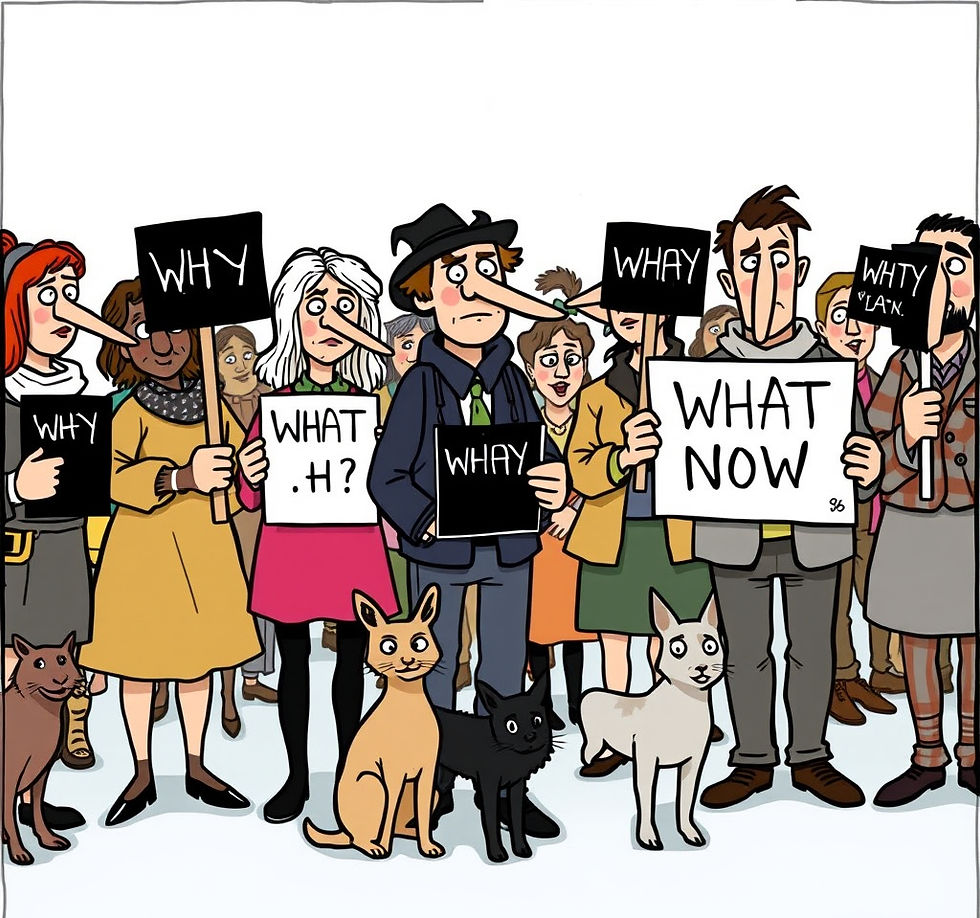
Ups and downs are an integral and unavoidable part of living on Planet Earth. Relatively few people go through life without ever having to face what appears as a daunting challenge at some point or the other. But for some people, certain ‘downs’ can be so excruciatingly painful—physically, mentally, emotionally or spiritually [generally, a combination of two or more of these]—that they turn into complete wrecks. This is especially so if they believe that they did nothing to deserve such a dreadful thing happen to them. Some people can spend the rest of their life agonizing over what they regard as undeserved suffering. They may be completely driven by the obsessive desire to know why they faced what they did, and yet may never get a convincing enough answer, which may cause them to become bitter, and even to give up on life altogether.
While it is often possible to locate the immediate cause of some painful occurrences (for instance, the immediate cause of a fractured foot may be because a person tripped on a stair and fell), the entire chain of causes and effects, one after another and stretching far back in time and far wide across space, that worked together for a particular occurrence to come into being at a certain point in time and in a certain place is impossible to fathom. Since we cannot get to understand the why of such an event in its entirety, to seek a complete explanation can become an exercise in futility.
In such cases, instead of agonizing over the ‘why’ aspect, a wiser approach might be to focus on the ‘what now’ aspect—that is to say, accepting as a undeniable fact or inescapable reality that a certain event has occurred (which, therefore, means recognizing that it now cannot be undone), to focus one’s attention on what one now can or should do in response to the event. Agonizing over the ‘why’ question of an event in our life can sometimes cause us to be stuck in the past, disabling us from offering a positive response to the event in the present. On the other hand, focusing on the ‘what now’ question can keep us firmly grounded in the present, thereby enabling us to come up with a meaningful response to the event. Obsessing about ‘why’ may sometimes leave us embittered and even more disempowered, while putting our attention on ‘what now’ can empower us with resilience and hope for being able to overcome the challenging situation that the event has given rise to.
These ideas were suggested to me recently on going through a book titled Marriage Undercover: Thriving in a Culture of Quiet Desperation, co-authored by Bob and Audrey Meisner. Based in Canada, the couple, who have been well-known Christian preachers, refer to themselves as ‘marriage conference speakers’. In their book, they share the story of how they managed to handle Audrey’s extramarital affair and ensuing baby in such a remarkable, spiritually mature manner that it all ultimately worked for the good.
While telling his side of the story, Bob writes, ‘Knowing why Audrey committed adultery would not change the fact that it happened. Regardless of how natural a desire it may seem, the desire to know “why” ultimately is a fruitless pursuit. Asking “why?” locks us in the past, which causes us to miss what God is saying and doing in the present, and keeps us from being prepared for the future.’ The ‘why?’ question, Bob opines, ‘hangs us up every time. All it leads to is frustration.’
On the other hand, Bob explains, ‘Asking “what now?” puts us in a mind-set to hear from God. It enables us to respond to the prompting of the Holy Spirit right now to do what we are supposed to be doing right now.’ He adds, ‘When we learn to resist the “why?” question and instead ask “what now?” we bring glory to God because we are surrendering our presumptuous “need to know” for simple trust in the grace of God.’
One does not necessarily have to share all of Bob’s theology to recognize the considerable merit in the basic points he makes here.
To not yield to the temptation to squander our life agonizing about the ‘why?’ or complete chain of causes of a painful event certainly does not mean to condone or to approve of the event. It is a simple recognition of the fact that comprehension of the entire gamut of causes and conditions that, working together, led to the event occurring may be impossible for us. at least as of now. Given this, a wise course might be to recognize the fact of the event having occurred and then to place our attention on what can be done, in the present moment, to address the situation that has arisen in the wake of the event. That is precisely what Bob and Audrey chose to do, as they bravely recount in their immensely absorbing book. Accepting (without condoning or approving) the fact that Audrey had done what she did, the couple were able to turn their focus on ‘what now’ or what they needed to do given that the event had occurred. The remarkable difference this approach made to their lives you can come to know if you read their richly instructive book!



This is an excellent essay and has stimulated my thinking. I suppose that I completely agree with its teachings. However, it encourages me to both continously try to understand reality better as well as what I should do in the future based on that understanding. Yes, that bad thing happened and I might never completely understand why it did. Yet for my sanity and wisdom, I should understand it as well as I can, so that I can respond to it as well as I can.
That wife cheated on her husband and got pregnant. Did she do that because her biological drives and sexually permissive culture strongly encouraged her to do so? Did she also do it because her…
Nice insightful article dolcykidy. Write more articles!🍞💘💘😄💕🌹🎉👑👑🐈💗😊😁👍🤗🌄🍍🥳🎁🐿️🐒🥹🍰🦒🦒😺😺🙏🤩